Your Customers Are Being Told AI Will Save Them Money. That Changes What They Expect From You.
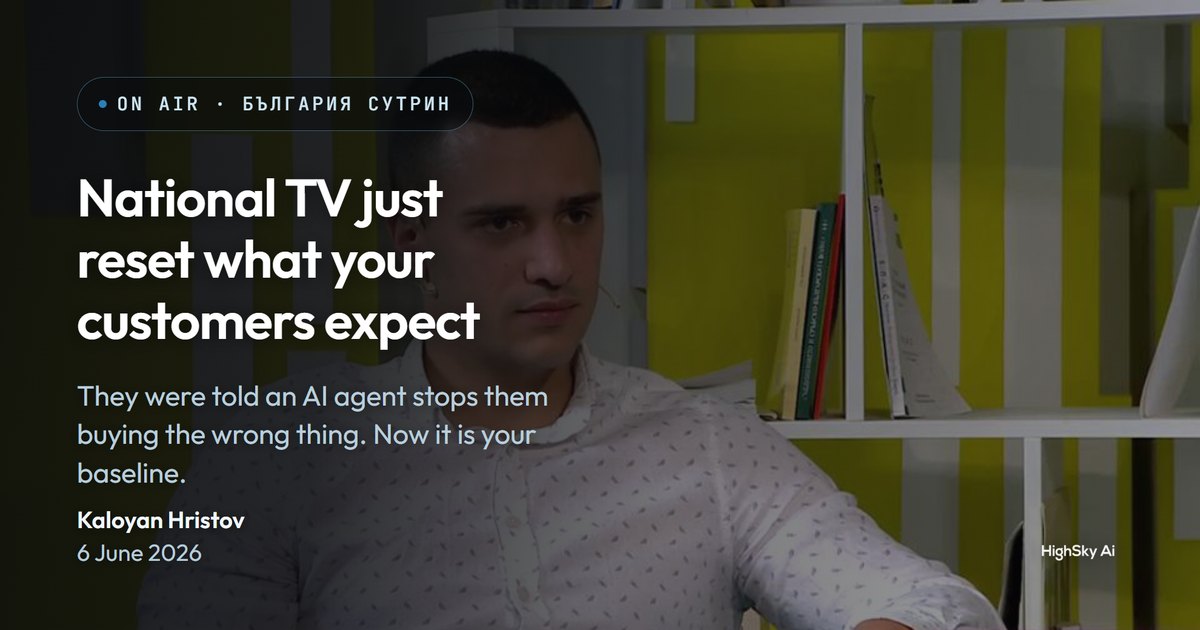
On a Saturday morning in June, a national television audience that was not thinking about e-commerce technology was told something specific: an AI agent can stop you buying the wrong thing.
The segment ran on ON AIR's weekend programme Bulgaria in the Morning, with our co-founder Kaloyan Hristov as guest. It was picked up and republished by dnes.bg. The framing throughout was consumer, not commercial. Not how stores make more money. How shoppers waste less of theirs.
If you run a large online store, that is the segment worth paying attention to, and not because of what it says about the technology.
It is because of what it does to the baseline.
The Argument Made to Consumers
The core of it was an idea most retailers never say out loud, because it sounds like it works against them:
"If you buy something wrong, you'll have to buy another product."
That is the entire consumer case in one sentence. The expensive part of a bad purchase is not the purchase. It is the second one, made to correct the first.
Hristov's illustration was one he has used before, and it lands because everyone recognises it. A colleague spent three days working out which laptop suited his needs. Forums, comparison articles, specifications he had to learn the meaning of before he could evaluate them. The same decision, with an agent that can answer questions about a specific catalogue, is twenty to thirty minutes.
Three days of unpaid research, or half an hour of conversation.
He was also careful about what the technology is, using the framing he uses consistently: artificial intelligence as "a very good search engine with a very large volume of data." Not a mind. A retrieval system fast enough and broad enough to do the comparison work the customer was otherwise doing by hand.
And on the limits: machines still cannot demonstrate real creativity. Which is fine, because choosing a laptop does not require any.
Why This Is a Merchant's Problem Now
Here is the shift that matters, and it has nothing to do with whether you buy anything from anyone.
Customer expectations are not set by your category. They are set by the best experience a person has had anywhere, and increasingly by what they have been told is possible. A national broadcast explaining that shoppers should expect to describe a need and receive a considered answer does not stay contained to the stores that offer it.
It becomes the standard your product grid is measured against.
Three days of self-directed research used to be normal. It was what shopping for a complicated product involved, and nobody blamed the store for it. Once a customer has been told that this is a solved problem, the three days stop reading as diligence. They read as your site failing to help.
That is a reputational shift happening in the background, on television, without any merchant's participation.
What Follows for a Large Catalogue
Two consequences, both practical.
The customers you are losing are the ones who needed the most help. A shopper who knows exactly what they want will find it through search and buy it. The one who has a problem rather than a product in mind is the one who leaves. That customer would have converted at a higher basket value, because a problem usually needs more than one item to solve. They are also the customer who now knows the alternative exists.
Returns are a discovery problem wearing a logistics costume. A meaningful share of what comes back was never the right product, and the decision that made it wrong happened before checkout, in the moment nobody was there to say the thing our founder describes as the mark of a good assistant: no, this is not right for you, but this is.
Neither of these shows up as a line item. There is no dashboard for the customer who quietly gave up, and returns get filed as an operations cost rather than a consultation failure.
The Honest Version of the Consumer Promise
We should be careful with the framing that a consumer segment naturally produces, because the version a merchant hears can sound like a threat.
An agent that helps a customer avoid a wrong purchase is not an agent that suppresses sales. In practice the same conversation that rules one product out rules two others in, because a customer who explains their situation has usually described a need that takes more than one item to meet. Someone buying a laptop for a specific kind of work needs the right laptop, and often the dock, the warranty and the storage as well.
What actually goes down is the proportion of transactions that reverse. What goes up is the proportion of customers who complete a considered purchase and come back for the next one.
That is a different business from one optimised to close the session. It is a better one, and it is measurable in the two numbers that matter after the sale: return rate and repeat rate.
What to Do With This
Nothing about the segment obliges anyone to buy anything. But it is a reasonable prompt for two internal questions.
First: in your highest-consideration category, how long does it take a customer with a real need but no product knowledge to reach a confident decision on your site? Not a customer who knows the SKU. One who knows the problem.
Second: what proportion of your returns are the wrong product rather than a faulty one? If you have that number, you already know the size of the opportunity. If you do not have it, that is the more interesting finding.
If you want to see the difference on your own catalogue, we run demos on real product data rather than a prepared scenario.
FAQ
How does an AI agent save a shopper money? By reducing wrong purchases. The expensive part of buying the wrong product is the replacement, plus the time spent on the return. A system that understands the need before the checkout prevents the cycle rather than processing it.
How much research time does it actually remove? For a high-consideration product, the difference is days of self-directed research versus a conversation of twenty to thirty minutes. The saving is largest where the buyer needs technical knowledge to evaluate the options.
Does helping customers avoid purchases reduce revenue? Not in practice. The conversation that rules one product out usually rules others in, because a described need often takes several items to meet. What falls is the share of transactions that reverse as returns.
Why should a merchant care about a consumer-focused TV segment? Because customer expectations are set outside your category. Once shoppers are told that describing a need and getting a considered answer is normal, an unassisted product grid starts to read as a failure rather than a standard.
Where does this help least? Low-consideration purchases where the customer already knows exactly what they want. The value scales with how much knowledge the buyer needs in order to choose correctly.
Kaloyan Hristov is CEO and co-founder of HighSky AI and appeared on ON AIR's Bulgaria in the Morning on 6 June 2026. The segment was republished by dnes.bg. HighSky AI builds the SkyCommerce Suite for large online stores: AI Sales Agent, AI Search Engine, AI Voice Agent and Process Automation.