Why the Biggest Online Retailers Are the Most Underserved in the Age of AI
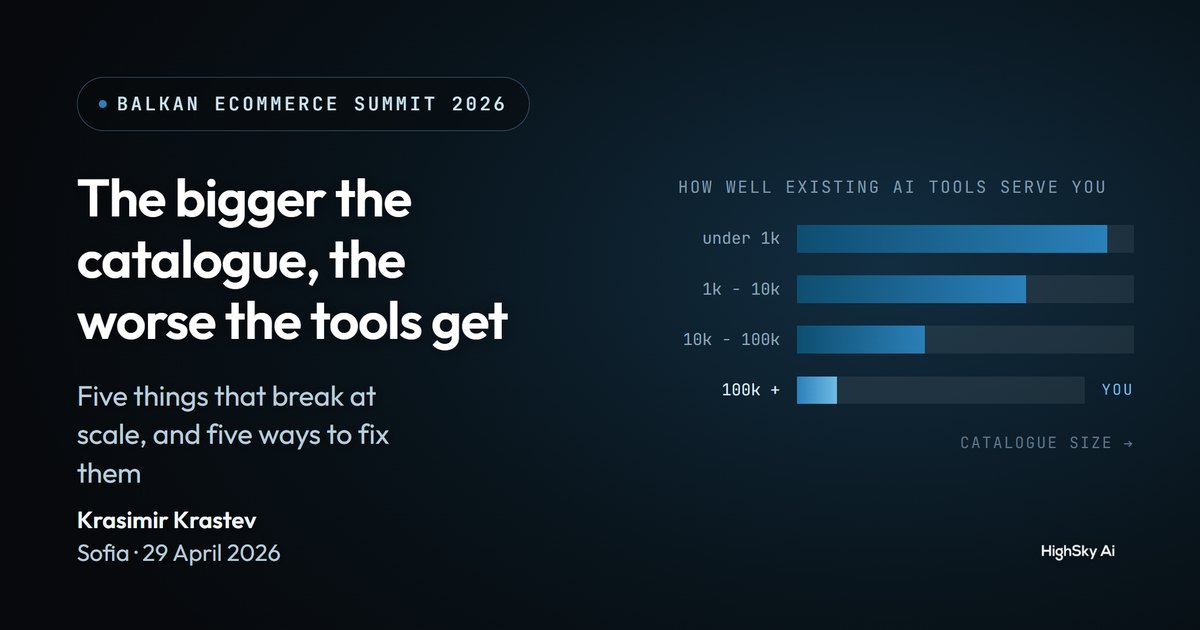
The premise of the talk was a contradiction, and it was in the title.
At Balkan eCommerce Summit 2026 in Sofia on 29 April, Krasimir Krastev, our Chief Product Officer, stood up in front of a room of e-commerce operators and argued that the largest online retailers - the ones with the deepest catalogues, the best-trained teams and the most sophisticated infrastructure - are the ones this technology currently serves worst.
"The bigger the business, the less successfully it adapts to change and to new technologies."
That is not a dig at large retailers. It is a structural observation. The things that make a big company good - complexity, expertise, depth, a back end that handles real volume - are the same things that make it hard to change. Every one of them raises the cost of moving.
He then spent fifteen minutes on the specifics: five things that break precisely because you got big, and five things to do about them.
Five Things That Break at Scale
1. The catalogue trap
A large electronics, fashion or media retailer carries somewhere in the range of 20,000 to 30,000 SKUs. And they invest heavily in making that catalogue good: detailed descriptions, quality photography, careful comparisons between products.
Then the average customer encounters a fraction of it.
"What they invest the most time in becomes the biggest bottleneck."
This is the part worth sitting with. The catalogue is not a weakness that needs fixing. It is an asset that has become unreachable. Years of merchandising work, sitting in a warehouse nobody walks through.
2. Eight seconds
Krastev framed attention historically, using television. In the eighties and nineties a sitcom ran twenty minutes - ten of content, ten of advertising - because average sustained attention sat around ten minutes. By 2021, sitcoms ran thirty.
His figure for 2026 is eight seconds.
"Eight seconds is everything you have to turn the customer around."
Now hold that against the previous point. Tens of thousands of products, eight seconds of attention. As a task specification, it is not difficult. It is impossible.
3. A six-inch screen
He put mobile at around three quarters of shoppers. And the ones still on desktop are largely the ones you have already won.
So the eight seconds have to happen on a phone. On that screen you have to distribute the information correctly, connect with the shopper, and convert - all inside the window.
Desktop-era navigation patterns do not survive that constraint. Filters, faceted search and category trees were designed for a screen that gave you room to browse. Nobody browses a 30,000-item catalogue on a phone on the way home from work.
4. Generic recommendations
The behavioural shift here is generational. Krastev described a shopper who does not start at Google, looks at Reddit and TikTok instead, and wants a recommendation handed to them.
"They want intent and a recommendation."
Not a comparison grid. They do not want to be equipped to decide. They want to be guided.
His example: someone searching for a present for a six-year-old. If the store returns 260 possibilities, the store has failed, no matter how relevant all 260 are. Choice was the value proposition of e-commerce for twenty years. At this scale it has become the friction.
5. The bottleneck moves
This was the challenge the room reacted to most, because it is the one that arrives after you succeed.
He described an operation with 25 operators working across seven separate systems - ERP, WMS and the rest - producing dozens of impossible or delayed orders every day. That is what happens when conversion improves and the back office was not prepared for it.
"Even if you are perfect at automating the front end, the sales cycle, you still have a human bottleneck in the back office."
Fix the front of the store and the pressure does not disappear. It relocates.
Five Things to Do About It
1. Search that understands intent
The reframe here is the most useful line in the talk:
"People know what they want to do, not necessarily what they want to buy."
Behind every query there is an intent, and that intent is rarely one product. It is usually a whole path, or a solution.
"I am going to a six-year-old's birthday. What can I get them?" is not a keyword. Handled as an intent, one query becomes several products and a full basket. Handled as a keyword, it becomes an empty search or 260 results, which are the same outcome.
That is the job of AI search: not to match text, but to work out what the person is trying to accomplish.
2. An unlimited personal shopper
"A human agent is limited by time. This one is not."
The mechanism is not that the AI is a better salesperson. It is that it has no queue and no shift. It can stay in a conversation for as long as the customer needs to work through a decision, and it can do that with every customer simultaneously.
Krastev was careful about why humans cannot: "Not because people are bad. They have salaries. They cannot give 45 minutes to one customer."
That is the honest version of the argument. A good consultant would give the time if the economics allowed it. They do not.
3. It remembers
A store should know who you are, what you bought, and when you might need it again.
His example was supplements. A customer bought protein and amino acids. Next visit, the system proactively offers the next step, because it knows where the customer is in a regimen rather than treating the visit as a first arrival.
A second example: a customer who cooked lasagne. The system remembers the recipe and the brands they chose, and recommends along that path.
The commercial point is that memory does not only help the customer. It gives recommendations somewhere useful to point.
4. Recommendations that follow your strategy
This was the section aimed squarely at commercial directors.
"The algorithm serves your business goal, not the other way round."
His illustration: a television might carry a 5 percent margin, while an HDMI cable carries something in the hundreds of percent. A recommendation engine optimising only for relevance will sell you the television and stop. A system pointed at the business goal recommends the cable, the stand and the wall-mount protection alongside it.
The strategy should reflect brand identity, the marketing plan, which promotional campaigns are live, and seasonality. None of those are things a generic "people also viewed" widget knows about.
5. Agentic back-office automation
Which returns to challenge five. Front-end automation alone moves the problem rather than solving it.
Closing the loop means the chain runs end to end: agent handles the conversation, checkout completes, the order enters the ERP automatically, the document flow generates itself, fulfilment proceeds without a human keying anything in. That is what process automation is for, and it is why we do not sell the conversation layer on its own.
His line on partial implementations is the one to remember:
"Piece by piece does not work. It is like 95 percent accuracy. It is simply not enough."
Anyone who has run an operation where 5 percent of orders need manual intervention knows that 5 percent consumes a disproportionate share of the team's day.
The Closing Argument
He finished by taking three excuses off the table.
"Your large retailer does not have a product problem. They do not have a platform problem. They do not have a technology problem."
"They have an experience problem. And that is what we have to solve."
That distinction is the reason a large retailer should be sceptical of most AI pitches they receive. Tools sold on catalogue enrichment, platform migration or model access are all answering questions the big retailers already answered. The unanswered question is what happens in the eight seconds a customer spends on a phone trying to find one thing among thirty thousand.
What We Showed at the Booth
Alongside the talk we ran SkyCommerce live on real catalogues for two days: the AI Sales Agent holding conversations with whatever visitors typed at it, and AI Search taking natural-language queries instead of keywords.
The most common reaction was not to the answers. It was to the follow-up questions the agent asked before answering, which is the part that does not come across in a screenshot.
If you talked to us at the booth and want to pick the conversation back up on your own catalogue, that is a demo rather than a deck.
Krasimir Krastev is Chief Product Officer at HighSky AI, with twelve years in digital transformation, automation and AI across e-commerce, fintech, igaming and the public sector. HighSky AI builds the SkyCommerce Suite for large online stores: AI Sales Agent, AI Search Engine, AI Voice Agent and Process Automation.