"I Really Hate the Word Chatbot": How AI Shopping Agents Actually Work
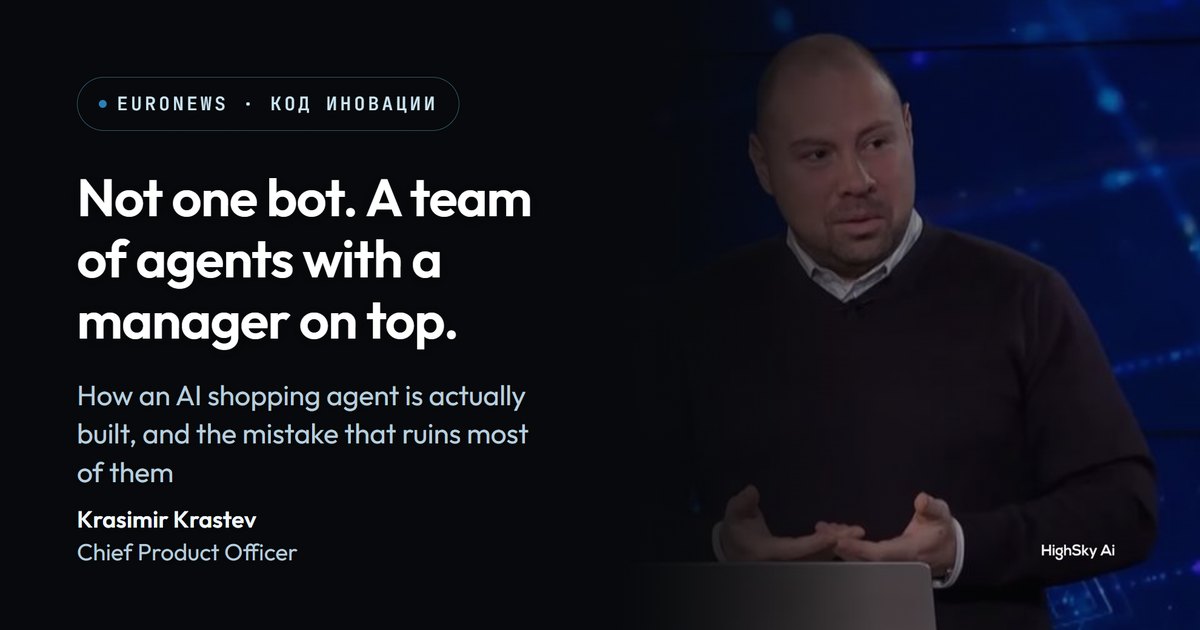
Ask most people what an AI shopping assistant is and they will describe a chat window. One box, one bot, one conversation.
That description is wrong, and the person who builds these systems for large online stores would rather you stopped using the word entirely.
"I really hate the word chatbot," Krasimir Krastev said on Euronews Bulgaria's innovation programme Kod Inovatsii, "because these are extremely complex systems."
He then explained what is actually behind the chat window. It is worth understanding, because the difference between the two architectures is the difference between a tool that annoys your customers and one that sells.
It Is Not One Agent. It Is an Orchestra.
Krastev used a comparison from a film he had watched the night before. A crew lands on an unknown planet with a robot, and the robot puts on a spacesuit it does not need. Why? "Because that way you accept me more naturally."
The chat window is that spacesuit. It is the interface humans find comfortable. Behind it, the architecture looks nothing like a single bot.
"This is a system of many agents, agents with an orchestrator on top, a manager on top. Imagine that each agent does a specific task."
In a grocery deployment, that means:
- An agent that understands the products
- An agent that understands dietary regimes
- An agent that understands the suppliers
- An agent that can check which delivery slots are free
- An agent that handles the cart
- An agent that handles payments
- A manager above all of them that makes the routing decisions
This matters commercially, not just technically. A single general model asked to do all seven jobs will do all seven adequately and several of them wrong. A specialist agent with one job, supervised by a coordinator that can spot when it is out of its depth, behaves differently. When an agent is not confident, the design lets it hand off rather than guess.
That is the actual answer to "what stops the AI from inventing things about my catalogue." Not a better prompt. A different structure.
Where the Technology Is Already Better Than a Person
Krastev was asked directly where the technology beats humans and where it does not. On online shopping specifically, his answer left no room:
"I think the technology is already better than a person, and it is better everywhere. Above all from the point of view of the attention paid to the buyer."
The reasoning is about scarcity, not intelligence. "However much we would like it, these days it is extremely difficult for a buyer to get attention from a sales consultant, for it to be long enough and thorough enough that they actually make an adequate purchase. In the mass case it is even impossible."
Nobody is arguing the AI is cleverer than a good salesperson. The argument is that a good salesperson cannot give forty uninterrupted minutes to every customer who needs it, and something that has no shift and no queue can.
This is also why he frames the whole category as reactive rather than visionary. Attention spans are shrinking, screens are getting smaller, information has to arrive faster and more condensed. AI is the thing that condenses it. "Quickly, in a timely way, and in the place where it needs to be used."
And the retailers who benefit most are the ones who invested hardest in the thing that stopped working: "This is of exceptional benefit to the large merchants with extremely complex catalogues, who have put a terrifying amount of time and resources into developing those catalogues, so they are as exhaustive as possible, with as much information as possible. But unfortunately, in the era where we want to get it on a phone screen in 30 seconds, that becomes very difficult."
Your catalogue is not too small. It is unreachable.
The Manipulation Question, Answered Honestly
The interviewer asked whether AI can be used to manipulate what customers search for and choose. Whether a merchant could rig the recommendations.
Most vendors deflect this. Krastev did not:
"Absolutely, categorically yes. And unfortunately, no. Unfortunately, at the moment that is a choice the merchants themselves make."
He explained the mechanism plainly. Recommendation systems come in several kinds. An AI agent can incorporate all of them, but the priority always belongs to whoever writes the brief. If a business owner instructs the system to push a category this week because the margin is best, that is what happens.
"Here the decision lies entirely with the merchant, with the business owner."
This is an uncomfortable thing to publish. It is also the only credible answer, and it sets up the part of the interview that most e-commerce operators have not thought about.
Personalisation Without Personal Data
If the system watches every move a customer makes, how does that sit with data protection? Krastev's answer draws a line that is easy to miss.
"While the machine follows every move, it understands personalisation differently. It understands the buyer and the customer as a system of preferences, of tastes, of views about the world, of actions they perform. But the system is not interested in any way in their personal data."
In practice, a customer profile inside such a system is a combination of tastes, things searched for, things probably bought before, and how to help that person make a better and faster choice now. What it does not want is identity.
"A system like this is in no way interested in your age, your name, your location, or things that in practice would be sensitive user data."
Two things follow from this. Personalisation and privacy are not on a single slider where more of one means less of the other. And a preference model is portable in a way an identity file is not, which is exactly why it can improve results without accumulating the kind of data that turns into a liability.
On the infrastructure side he was equally specific about where data sits. Closed third-party models get used, but narrowly: "only for specialised tasks, such as summarising information, structuring it in a more correct way so another model can understand it." The rest runs on generative models that are local and specific to the client's business, because "the processing of the information, the aggregation and the memory, the personal data, the specialised data for the store, should never leave our infrastructure and that of the client."
Europe Is Not the Brake. It Is the Filter.
Asked whether European regulation will discipline business or slow it down, Krastev argued the premise was wrong.
"I do not think Europe can slow business down. European regulation and the European act for control of artificial intelligence is in fact something exceptionally useful for Europe, because it restricts the behaviour of disloyal players."
His case for it is ethical rather than commercial. Every developer has to look at what they build from a moral side as well as a business side, and the manipulation risk in the previous section is precisely why. Right now, large numbers of people believe things generated by AI without knowing how to check them.
"European regulation in practice stops us from turning into certain other countries, where artificial intelligence, besides being used for manipulating moods and behaviour, collects a terrifying amount of information which it is then legal to sell and reuse."
If you are evaluating AI vendors, that is a useful lens. A supplier who treats the EU AI Act as paperwork to survive is telling you something about how they will treat your customers' data.
The One Mistake That Ruins AI Projects
This was the most practical minute of the interview. Krastev has worked in the AI business for more than ten years and says he sees the same single failure, over and over:
"The inability to define the brief."
The pattern is consistent. A business that is not educated enough on the topic assumes AI or automation is a panacea that will suddenly solve every problem. So instead of building something defined, with clearly predictable and measurable results, the brief keeps expanding.
"It gets complicated to such a degree that the results are no longer measurable, and we no longer have enough information, or even the administrative and human resource, for that automation, that artificial intelligence, to be first fed correctly, second trained correctly, and third monitored correctly."
Fed, trained, monitored. Skip any of the three and the project produces what he calls terrible results, and the technology takes the blame.
So what should a business do first? Decide exactly what it wants to use the AI for. Then answer honestly whether it holds enough information for the system to be trained properly. And then apply a test he borrowed from Einstein: if you cannot teach something you understand to a sixth-grader in four sentences, you do not understand it well enough.
"Can I explain to it exactly what it has to do and in what way, in ten sentences or fewer? That is the base you have to start from."
If the answer is no, the problem is not the model.
What Happens to Human Support
Krastev's prediction here is blunter than most, and shorter: commercial support will largely disappear, "in three or four, not even ten years."
But he framed it around who is doing the work rather than headcount.
"Human support is something that is done out of necessity, not out of desire. Personally I do not believe there are many people who get up in the morning burning with the desire to service customer requests all day. They would prefer to do something else, and so the business would have the chance to utilise them in another way."
That is the honest version of the automation argument. Not that people are surplus. That the specific task of answering the same forty questions is not what anyone wants their day to be, and a business that stops spending human hours there gets those hours back for work that needs a person.
Where the Limits Actually Sit
The last question was about the limitations of these agents. The answer is a good sentence to keep:
"The limitations of these agents extend as far as the world they see."
Imagine them as small employees taught to do one, two, three or five tasks. Their limits are the tasks they were taught. They are not released into the open world, and that is a design decision rather than a shortcoming. What makes the system capable is not one agent that can do anything, but a library large enough that the right specialists can be picked for each specific case.
Which brings the whole interview back to where it started. Not a bot in a box. A structured team, with a defined brief, bounded on purpose.
That is the part the word "chatbot" hides.
FAQ
What is the difference between a chatbot and an AI shopping agent? A chatbot answers a limited set of predefined questions. An AI shopping agent is a system of specialised agents coordinated by a manager agent, which performs actions on the customer's behalf - checking stock, building the cart, applying a discount, completing the order.
How does a multi-agent architecture reduce wrong answers? Each agent covers one domain, so no single model is asked to be an expert in everything. The coordinator routes each request to the specialist and can hand off instead of guessing when confidence is low. Product answers come from querying the live catalogue rather than from model memory.
Does an AI shopping agent need my customers' personal data? Not for personalisation. The profile it works from is a set of preferences, past searches and likely prior purchases. Names, ages and locations are not what makes the recommendation better, which is why a well-built system does not collect them.
Does the EU AI Act make AI harder to deploy in e-commerce? It constrains specific behaviours rather than the technology. One concrete requirement is that a person must be told they are talking to a machine. In practice the act filters out operators who were relying on things a responsible vendor would not do anyway.
What is the most common reason AI projects fail in retail? An undefined brief. When the goal keeps expanding, results stop being measurable and the system never gets fed, trained and monitored properly. The fix is upstream of any technology choice: decide the one job, confirm you hold the data for it, and be able to explain it in ten sentences.
Krasimir Krastev is Chief Product Officer at HighSky AI and spoke on Euronews Bulgaria's Kod Inovatsii. HighSky AI builds the SkyCommerce Suite for large online stores: AI Sales Agent, AI Search Engine, AI Voice Agent and Process Automation. If you want to see the architecture running on a real catalogue rather than described, take the product tour.