Two Ways People Fail at a Large Catalogue - and Why Neither Is About Gender
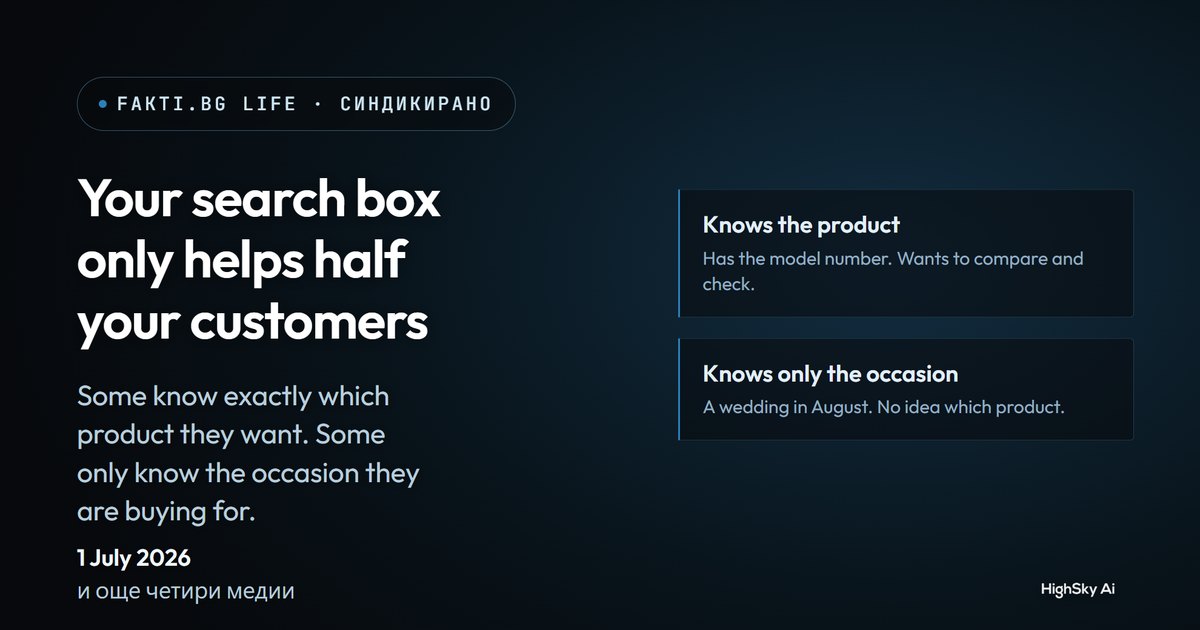
At the start of July a feature about our agents ran in three Bulgarian publications. It opened with a claim about what women get wrong when they shop, and continued with a claim about what irritates men.
The observation sitting underneath that framing is real, and we recognise it from the transcripts of actual conversations. The framing itself does not survive contact with the data, and it does not travel at all to the audience we build for. So this is the version we would have written.
The variable is not who the shopper is. It is what they walked in with.
Mode one: they know the occasion, not the product
Someone needs a gift for a twelve-year-old who is "into science". Someone needs shoes for standing on concrete for nine hours. Someone needs a present for a colleague they do not know well and a budget they will not exceed. None of these people can type a useful query, because a search box asks you to supply the answer as the input. Product name, category, filter. The one thing this shopper does not have is the name of the thing they want.
What they do instead is browse. On a catalogue of ten thousand products, browsing is a slow way of discovering that you did not know what you were looking for. On a catalogue of two hundred thousand, it is a way of leaving.
The syndicated piece described this as women struggling to make a fast choice. What it actually is: intent expressed as a situation rather than a specification. Plenty of people arrive that way. The gender of the person typing has nothing to do with whether the search index can parse "something for my dad who has every tool already".
A system built for this mode has to do one specific thing: ask. Not a form with eleven fields, but the two or three questions a floor assistant would ask before pointing at a shelf. Budget, who it is for, whether it needs to arrive by Friday. Then narrow to a handful of products with the reason attached to each.
The reason matters as much as the shortlist. A recommendation without a because is just another list.
Mode two: they know the specification and want to interrogate it
The other shopper arrives with a part number, a compatibility requirement, or a tolerance they will not compromise on. Will this fit a 2014 model. What is the actual thread pitch. Is the certification the current one or the superseded one.
This person is not browsing. They are auditing. And they abandon for a completely different reason than the first shopper: they abandon because getting a straight answer requires four page loads, a specification PDF, and eventually a contact form.
The press version described this as men being annoyed by too many questions. Closer to the truth: this shopper resents every step that is not an answer. Being asked for an email address before receiving a fact is the specific failure. It converts a two-minute decision into a task for later, and later does not arrive.
This is why we say the two halves belong together. Question answering that cannot reach live inventory produces confident nonsense. Search that cannot answer a follow-up produces a shopper with a shortlist and no way to choose. The AI Sales Agent and the AI Search Engine are one system for this reason, not two products we happen to sell.
The third mode is a clock, not a person
Both of the above happen disproportionately when the store is closed.
We measure this rather than estimate it. Across SilaBG between March and May 2026, 30.7 percent of interactions happened outside business hours. Roughly a third of the conversation volume, in the window when there is nobody at a desk to take it.
Notice what this does to the other two modes. The shopper who needs to be asked two questions gets asked nothing. The shopper who needs one fact gets a contact form and a promise of a reply within one working day. Both of them were ready to buy at 22:40 and neither of them is there at 09:15.
This is the least glamorous argument for automating the top of the funnel and probably the strongest one. It requires no belief about artificial intelligence at all. It only requires accepting that a third of your demand arrives when your staff are asleep.
One thing in that coverage we need to correct
The syndicated version closes with a line we would not have written: that the system continuously learns from the data it generates, and the more it is used, the more intelligent it becomes.
That is the industry's favourite sentence and it is not how this works. Our CEO said the opposite on Bulgarian National Television's Kultura.BG, in the same period the feature was running: left to manage on its own, a system like this drifts toward hallucinations and wrong answers. We covered that in six myths about chatbots, and it is myth number three.
What genuinely improves with use is the fit to one specific business - which objections recur, which product pairings customers discover, what vocabulary your buyers actually use. That accumulates through real interactions. It accumulates on top of deliberate setup, not instead of it. A system deployed without catalogue integration will not work it out by being used more. It will be wrong more often, faster.
We are correcting our own press coverage here because the alternative is letting a claim we do not believe circulate under our name. If a vendor tells you their system gets smarter on its own, ask them what happens in month three when nobody has looked at it.
What all three modes have in common
They are all cases of a shopper who was willing to buy and did not, for reasons that have nothing to do with price, product or advertising spend.
That is the part worth taking from the original story. Not the gender split. The fact that a large catalogue punishes the underspecified shopper, the interrogating shopper and the after-hours shopper in three different ways, and that all three of them were already on your site. You paid for them once.
The uncomfortable version of this argument is that the assistant sometimes has to talk someone out of a purchase - which is the subject of a good assistant says no, and the single hardest thing to sell to a merchant who is measured on this month's revenue.
If you want to see which of the three modes is costing you most, that is a question your own conversation logs can answer.
FAQ
Do men and women actually shop differently online? Population-level differences exist and are studied, but they are the wrong variable to build a system around. What determines whether a shopper succeeds on a large catalogue is whether they arrived with a situation or a specification, and whether the site can handle either. Build for the mode, not the demographic.
What is an underspecified query? One where the shopper describes a need rather than a product - "a gift for someone who cooks", "shoes for standing all day". Conventional search requires the product name as input, so it returns either nothing or everything.
Why do shoppers abandon when they already know what they want? Because the answer to their one question is behind several steps: a specification sheet, a page reload, a contact form. Each step is an invitation to postpone, and postponed purchases mostly do not happen.
How much online shopping happens outside business hours? In our own measured data for SilaBG between March and May 2026, 30.7 percent of interactions fell outside business hours. Figures vary by category and market; that one is measured rather than estimated.
Does an AI shopping agent get smarter the more it is used? Not on its own. It gets better fitted to a specific catalogue and customer base through real interactions, but only where deliberate setup and integration are in place. Without them, more usage means more confident errors, not fewer.
This article adapts a syndicated feature that appeared in Fakti.bg, Entrepreneur.bg, tvoite.technology, smartage.bg and pixelmedia.bg during late June and July 2026. HighSky AI builds the SkyCommerce Suite for large online stores: AI Sales Agent, AI Search Engine, AI Voice Agent and Process Automation.