"Every Action a Consultant Can Perform" - Including the One That Cuts Both Ways
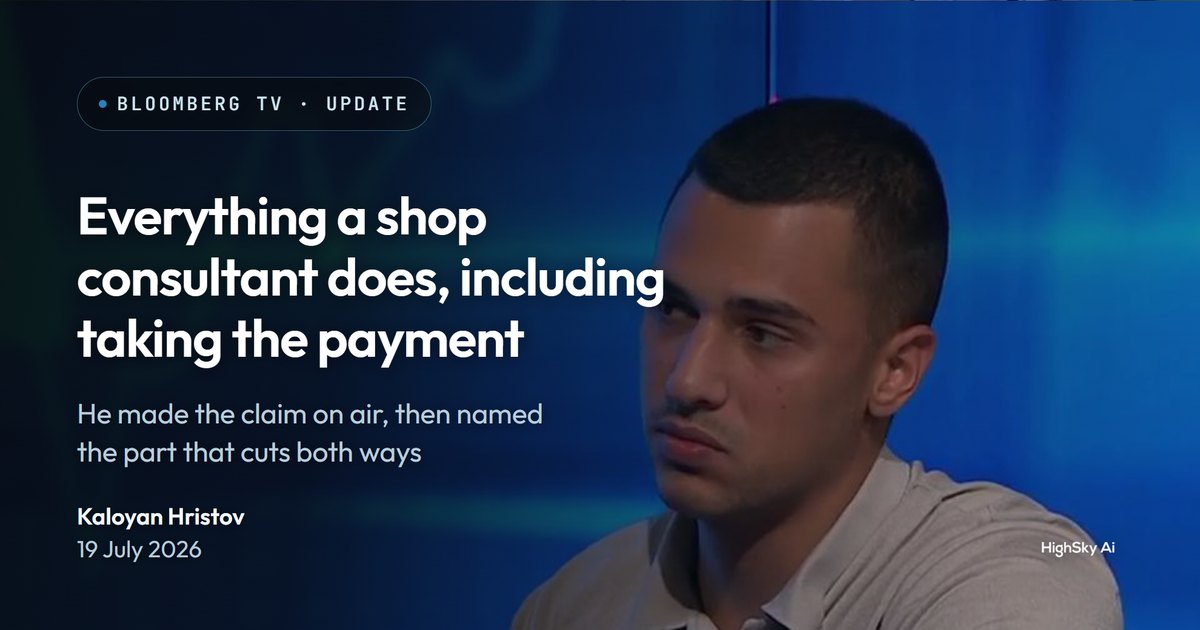
In July, Kaloyan Hristov returned to Bloomberg TV Bulgaria's UpDate, with Antoaneta Vasileva presenting.
He made a large claim and then, unprompted, undercut part of it. Both halves are worth taking seriously, and the second one is rarer.
The claim:
"Every action a consultant can perform, we replicate it in the online environment."
The qualification, a few minutes later, on payments:
"The agent is a double-edged knife."
Most vendors give you the first sentence. Very few volunteer the second on live business television.
What "Every Action" Actually Covers
The claim is more specific than it sounds, and it is the cleanest available definition of what separates an agent from a chat window.
Think about what a good consultant in a physical shop does across a single customer visit. They answer questions about products. They fetch alternatives when the first choice is wrong. They check whether something is in stock in the back. They tell you when it will arrive if it is not. They look up what you bought last time. They apply a discount if one applies. And they take you to the till and complete the sale.
Seven distinct actions, and only the first one is conversation. The rest are transactions against systems.
That is the line. A chatbot does the first. An AI Sales Agent does all seven, which requires live access to inventory, order history, pricing rules, promotions and the cart itself. Without those connections you have a well-spoken assistant that has to say "please contact our team" at the exact moment the customer was ready to buy.
Hristov also flagged where the effort went: "We emphasised changing this so agents make personalised recommendations." Which is the difference between an agent that can complete an order and one that knows what belongs in it.
The Double-Edged Part
The payments comment is the interesting one, and it deserves more than a passing mention because it describes a genuine tension rather than a marketing caveat.
An agent that can complete a purchase inside the conversation removes the biggest source of drop-off in online retail. The customer never leaves the conversation, never re-enters details, never hits a checkout flow designed in a different decade. That is the sharp edge working in your favour.
The other edge is that you have handed a machine the ability to move money.
Everything that was previously protected by the friction of a checkout page is now protected by how well the agent was built. Did it confirm the right product? The right quantity? The right price, including the promotion that should have applied? Did the customer understand what they were agreeing to when they said yes?
A mistake in a product recommendation costs you a return. A mistake at the payment step costs you a chargeback, a support case and a customer who tells other people.
This is why the architecture matters more here than anywhere else in the system. The pattern our team uses is a separate specialised agent for payments rather than one general model handling the whole conversation, with explicit confirmation steps before anything is committed. In the demo shown on national television earlier this year, the agent built the cart, synchronised it with the store, and then asked for confirmation of the price and whether that was everything, before offering delivery and payment options.
That confirmation step is not a UX nicety. It is the thing standing between a conversational checkout and an expensive incident.
Where the Honest Answer Sits on Manipulation
The segment also went into pricing recommendations and the potential for manipulation, which is now the third HighSky appearance where the question has been asked and answered the same way rather than deflected.
The short version of the company position: yes, a recommendation system can be pointed at margin rather than fit, and the choice belongs to the merchant who writes the brief, not to the technology.
What makes that more than a disclaimer is the operating consequence. If the merchant controls the objective, then the merchant is accountable for it, which means the objective has to be visible and reviewable rather than buried in a model nobody can inspect. An agent optimising for something you cannot see is a risk regardless of whether the optimisation is reasonable.
For a large retailer running an actual brand, this is the question to bring to any vendor conversation. Not "is it accurate." Accurate at what.
Who This Is For Right Now
Hristov was direct that the technology currently benefits large online stores most. That is consistent with everything else the company has said, and it is worth restating because it cuts against how the category usually sells itself.
The value scales with catalogue size and with how much knowledge a buyer needs in order to choose correctly. A store with two hundred products does not have a navigation problem that a customer cannot solve alone. A store with thirty thousand does, and no amount of filter design fixes it, because the customer would have to know which specification matters before they could filter on it.
The other half of the equation is data. An agent that can perform every action a consultant performs needs the systems behind those actions to be reachable. Inventory that updates. Order history it can query. Pricing rules it can apply. If those exist as separate systems that only humans reconcile, the agent inherits the same wall your team hits.
That is not a reason to wait. It is the actual scope of the project, and it is better known at the start than discovered in month three.
The Two Sentences Together
Taken alone, "every action a consultant can perform" is a capability claim, and capability claims are cheap in this category.
Taken with "the agent is a double-edged knife," it becomes something more useful: a description of a system powerful enough to be worth building carefully. The reason to say both on live television is that a buyer who only hears the first one will deploy without the confirmation steps, the specialised separation and the review of what the thing is optimising for, and will then blame the technology.
We would rather have the harder conversation before the deployment than the expensive one after it.
If you want to see what the payment path looks like in practice, including where it stops and asks, that is a demo on your own catalogue rather than a prepared scenario.
FAQ
What can an AI sales agent actually do beyond answering questions? Fetch alternatives, check live stock, confirm delivery timelines, review a customer's previous orders, apply a valid discount, build the cart and complete the purchase. Conversation is one of seven actions; the rest are transactions against live systems.
Is it safe to let an AI agent complete a payment? It is safe when it is built for it: a specialised payment component rather than a general model, and explicit confirmation of product, quantity and price before anything is committed. The confirmation step is what separates conversational checkout from an expensive incident.
Why does completing checkout inside the conversation matter? Because the handoff to a separate checkout flow is where a large share of ready buyers drop out. Keeping the purchase in the conversation removes a step that exists for the store's convenience rather than the customer's.
Can an AI agent be pointed at margin instead of customer fit? Yes. That is a decision made by whoever writes the brief. The relevant safeguard is that the objective is visible and reviewable, not that the vendor promises neutrality.
Which businesses benefit most today? Large online stores, where catalogue size makes unaided navigation impractical and where buyers need product knowledge to choose correctly. The prerequisite is reachable systems: live inventory, order history and pricing rules the agent can query.
Kaloyan Hristov is CEO and co-founder of HighSky AI and appeared on Bloomberg TV Bulgaria's UpDate on 19 July 2026. HighSky AI builds the SkyCommerce Suite for large online stores: AI Sales Agent, AI Search Engine, AI Voice Agent and Process Automation.