"AI Is Not Smart. It's a Very Good Search Engine." - Our Founder on What This Technology Can't Do
There is a version of this article that would be easier to write. It would open with a statistic, promise a transformation, and never mention a limitation.
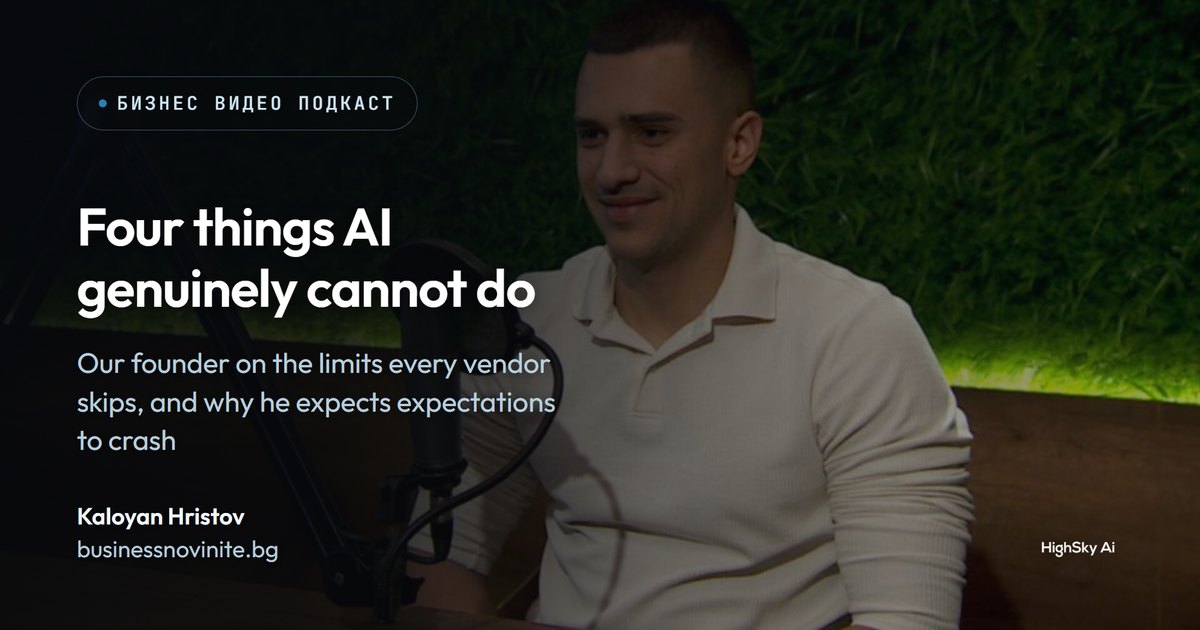
This is not that article. It is drawn from a long podcast conversation with Kaloyan Hristov, who built this company, and the most useful parts of it are the parts where he says what the technology cannot do.
"All people think this technology is genuinely smart, like a person is. It is actually not smart at all. It is a very strong, very good search engine."
If you are evaluating AI for a large online store, that sentence is worth more to you than any conversion promise. Here is the rest of the argument.
It Started With Suitcases
Before there was a platform, there was a problem the founders had themselves.
Kaloyan and his co-founder Teodor ran their own online store selling suitcases and bags. Large catalogue, and both of them working other jobs at the time. "We had no time at all to answer our customers' questions, and so we started looking for solutions, ready-made solutions, to help us with customer service."
They spent close to six months testing the tools on the market. Every one of them had the opposite effect.
"They drove customers away, because they did not work properly. They had preset answers, they felt extremely robotic. And people do not want that. People want a natural conversation, and to feel heard."
So they built their own, partly out of stubbornness. The first version cost them between 1,000 and 2,000 leva and it worked better than they expected. They gave it to a few friendly stores just to collect feedback, and that is where the actual business insight arrived:
"We saw that the bigger the store, the more monthly users coming to their site, the problem only scaled and got bigger."
That is the whole positioning in one observation. Not a market they picked from a slide. A pattern they noticed in someone else's data.
Since then the platform has taken over 300,000 EUR of investment - salaries and technical infrastructure - to serve the volume it serves now. Worth stating plainly, because "we built it in a weekend" is a story that only ever ends one way.
The Gap Kaloyan Is Actually Attacking
His framing of the core problem is a comparison, and it is the clearest articulation of why this category exists.
In a physical store, he puts conversion at roughly 30 to 40 percent. Online, "the conversion rate is between 2, 3, at best 4 percent." The monthly cost of running the physical store is enormous; the monthly cost of running the online one is far smaller.
So why does the expensive channel convert an order of magnitude better?
"In a physical store you can quickly find what you need. And if you cannot, you can always ask someone to point you to exactly what you need. You know your problem, but you do not know exactly what to buy to solve it."
Then the line that should make any e-commerce director uncomfortable:
"Online, people are left to browse completely alone, with no supervision at all, and they cannot orient themselves."
He extends it into an image worth stealing. Imagine walking into a physical store where there is nobody at all. You cannot steal anything, you are simply left to fate. What are the odds you buy something, compared to a store where someone meets you at the door and asks whether you would like a coffee?
"Just because of that treatment you receive, the chance that you buy increases enormously."
Most large online stores are the empty shop. Not because they are badly built. Because navigating 20,000 or 30,000 items alone, on a phone, in a hurry, is a task nobody actually completes.
Four Things AI Genuinely Cannot Do
This is the section that no vendor deck contains. Asked about the biggest current weaknesses of AI models, Kaloyan listed four.
1. They are built to agree with you. "Unless you have given it very good instructions, they are built to agree with you." Push back on a model with something slightly off, and it will start telling you how right you are. In a shopping context that is not a philosophical problem, it is a commercial one: a system that validates every assumption a customer arrives with is not consulting, it is flattering.
2. Hallucinations are not going away. "With these general models like ChatGPT, there is simply no way for them to be solved, because it predicts the next most suitable syllable, token. When you predict, there is no way not to get it wrong."
He acknowledges the counterargument - humans get things wrong too - and does not accept it as a resolution. "I do not see these hallucinations leaving."
Which is exactly why the architecture matters. If the model cannot be made reliable on its own, the reliability has to come from the structure around it: specialist agents, a coordinator, and product answers pulled from the live catalogue rather than generated from memory. We wrote about how that architecture works separately.
3. It cannot reason through a genuinely complex case. "It is still a machine. On a more complex case a human has to take over." It cannot show creativity or invent something new.
4. It needs somewhere to get the data from. "Perhaps its biggest limitation is that it has to have somewhere to take the data from in order to do the next steps, whether that is answering you or performing an action. If it has nowhere to take the data from, it actually cannot do anything."
Read those four together and you get a practical buying criterion. The question is not how clever the model is. It is whether the vendor has built the structure that compensates for what the model cannot do, and whether your business holds the data it needs to be fed.
He Expects the Expectations to Crash
Asked whether the AI boom is near its ceiling, Kaloyan reached for the adoption curve: a new technology arrives, expectations spike far beyond what it can do, the spike collapses, and only then does it climb into a steady line where people have understood what it actually does. That is where real productivity starts.
His read on where we are:
"Right now, in my opinion, we are exactly before the drop. People will realise that this technology is not magic, that it is not smart the way they think, and that it is just a very strong search engine. There will be disappointments."
But he does not treat the drop as bad news:
"After that we will find applications that are genuinely extremely useful. At the moment the market has filled up with AI tools for everything. It is nice to show something to friends, or to have a bit of fun, but to carry real value, I think we are still looking for exactly where it would bring the most value."
He is also clear about where the ceiling sits. Tools will keep getting added and the systems will keep doing new things, "but the intelligence underneath does not have far to go right now. An entirely new architecture has to be invented, and we are still far from that."
A vendor telling you a correction is coming is a vendor who expects to be here after it.
What He Sees Coming Instead
Two predictions from the conversation are worth planning around.
Interfaces converge on conversation. "People will start talking to the sites themselves." Either every page becomes heavily personalised based on your prior behaviour, or pages start to look more like a chat you can hold with the platform.
He grounded it in something small and recognisable. A colleague spent three days choosing a laptop - how much RAM, which processor, what battery, will it be enough for the work. "With an agent like this, the three days it took him could become 30 minutes. Ask all the questions, get the answers, make the decision and buy it."
Repeat purchases become conversations, not reorders. His example: you have ordered the same thing three times. An agent that knows this can open with something a shop assistant would say. Have you had results? Is it good? If not, try this. If it is, here is 10 percent because you are a loyal customer.
That is a different relationship with a catalogue than a "reorder" button.
Where This Works Best Today
Asked which businesses gain most, his answer was specific and it maps onto how we choose who to work with.
Heavily informational industries. Stores selling things where the customer needs some knowledge in order to make the right decision: supplements, electronics and technology of any kind, automotive parts, pharmacy, cosmetics.
"These industries need some specific terminology in order to know whether this is what I need, or something else, or a third thing. Simply wherever consultation is needed. Those industries are currently seeing the biggest boom and the biggest benefit from this type of agent."
Clothing shows solid gains too. But the heavier the information load on the buyer, the larger the gap an agent closes.
Two Honest Difficulties of Building This
Asked what is hardest, he named a market problem and a maths problem.
The market problem is education. "First people think this technology cannot do anything. Then we show them it can actually do these things, and after that they start thinking it can do everything." Both positions are wrong and both are expensive. "You have to explain very clearly where the limitations are, what it can and cannot do, and what the dangers are, because there are dangers."
The maths problem is one very few buyers think about. With standard software, each new user costs close to nothing. With AI, "every new user of the chat costs tokens, which cost money. As the users go up, your costs go up drastically."
Which means pricing has to be built so the client comes out ahead and the vendor does not go under, while the product stays useful and unlimited enough for customers. If a vendor cannot explain how their pricing survives your traffic, that is a question worth asking early. Ours is on the pricing page.
On Regulation, Before It Was Required
The EU AI Act is being enforced in Bulgaria from this summer. Kaloyan's worry is that it goes the way of data protection law: documentation people fill in and then do not follow, because states lack the resource and the trained people to check.
More interesting is what the company did before any of it was mandatory.
"From the moment this AI Act came out, when they first announced it, I think it was still 2024, we started complying with it back then, without being obliged to."
The concrete example is a rule with commercial consequences. A person has to be informed they are talking to a machine. It cannot present itself as human.
"We insist on this a lot. We have had clients who said, but can it think it is talking to a person? And even back then we told them no, that cannot happen, because it is not ethical."
Turning down a client request on ethical grounds, two years before a regulator could have fined you for honouring it, is a reasonable proxy for how a vendor will behave when nobody is checking.
What This Means If You Run a Large Store
Strip out the predictions and the founder story and a practical position remains.
The technology is not intelligent. It is an extremely capable retrieval and action layer, and it needs to be pointed at a well-defined job with enough data behind it. Its known weaknesses are structural, so what you should be evaluating is the structure built around them rather than the model underneath.
Where it earns its keep today is the gap between how a physical store treats a customer and how a website does. That gap is not closing on its own, and at 20,000 or 30,000 items it is getting wider.
We measure what happens after deployment rather than promise what will. One number worth having: across SilaBG between March and May 2026, 30.7 percent of interactions happened outside business hours. Roughly a third of the conversations, in the window when nobody is at a desk.
If you want to see what the system does with your catalogue rather than read about what it did with someone else's, that is what a demo is for.
FAQ
Is AI actually intelligent? Not in the way the marketing implies. It is very good at retrieving, structuring and acting on information it has access to. It does not invent, and it does not reason through genuinely novel complex cases. Systems that work in production are designed around those limits rather than pretending they are gone.
Can AI hallucinations be eliminated? Not in general-purpose models, because next-token prediction always carries error. They are managed structurally instead: specialist agents with narrow scope, a coordinator that can hand off when confidence is low, and product answers retrieved from the live catalogue rather than generated.
Why is physical retail conversion so much higher than online? Because someone is there. In a shop you can find things fast, and when you cannot you ask a person who points you to the right product. Online, customers navigate large catalogues alone, and most do not finish the task.
Which industries get the most out of an AI sales agent? Ones where the buyer needs knowledge to choose correctly: supplements, electronics, automotive parts, pharmacy, cosmetics. Anywhere consultation is genuinely required. Clothing benefits too, but less than the information-heavy categories.
Why do AI costs behave differently from normal software costs? Each conversation consumes tokens, so cost scales with usage rather than staying flat like a seat licence. That has to be handled in how the product is priced, or one of the two parties ends up underwater.
Is the AI boom about to end? Expectations probably correct before the useful applications settle in. The underlying capability keeps improving, but a step change needs a new architecture, and that is not close.
Kaloyan Hristov is CEO and co-founder of HighSky AI. The full conversation is available on Business Video Podcast. HighSky AI builds the SkyCommerce Suite for large online stores: AI Sales Agent, AI Search Engine, AI Voice Agent and Process Automation.