Six Myths About Chatbots, Taken Apart One at a Time
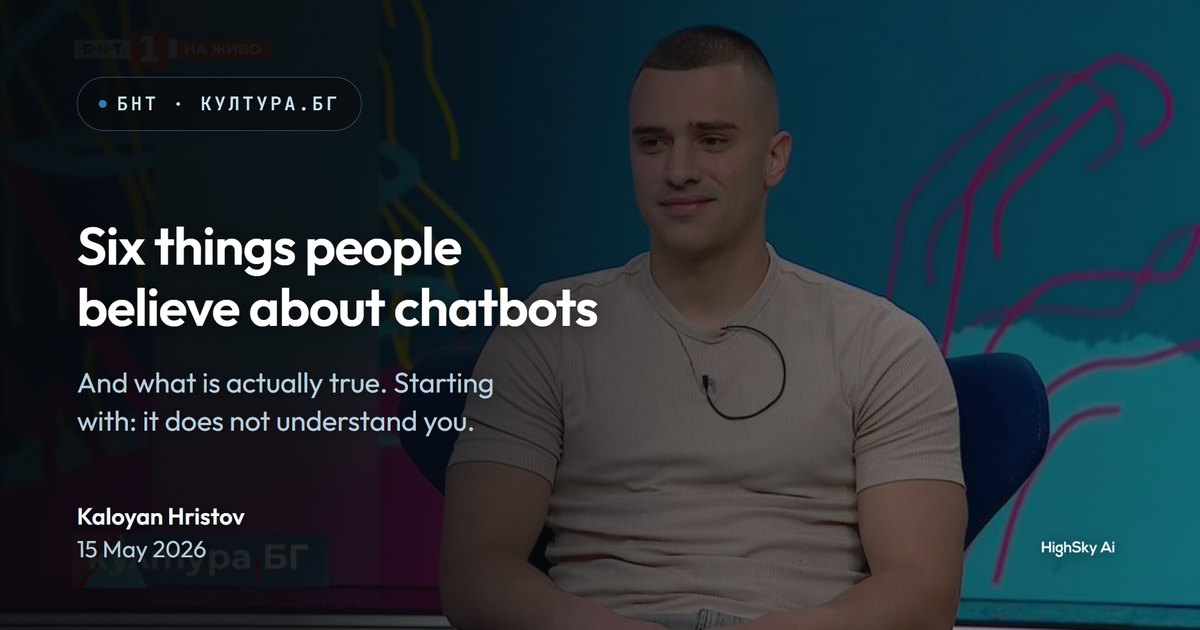
In May, Bulgarian National Television's culture programme Kultura.BG ran a segment on the myths and legends around chatbots, with our co-founder Kaloyan Hristov as its guest.
The choice of programme is the interesting part. Kultura.BG is not a business show. Its audience is not evaluating vendors or calculating return on a deployment. They are people who have encountered these systems as customers, formed opinions, and mostly formed them from the worst examples available.
Which is a useful place to start, because the misconceptions held by the general public are the same ones sitting inside procurement decisions at large retailers. They are just stated with more confidence there.
The programme opened with a definition worth keeping, because it is more precise than the way the word is normally used:
"The category 'bot' defines a type of software solution capable of performing some activity without human intervention. A chatbot imitates conversation with a person and can return feedback with information in various forms."
Note what that definition does not claim. Not that it understands. Not that it thinks. That it imitates conversation and returns information. Everything below follows from taking that seriously.
Myth 1: It understands you
It does not, and the distinction is not pedantic.
The clearest statement of this from our side came on the Business Video Podcast: "AI is not as smart as people think. It is rather a very good search engine."
A system that retrieves, ranks and reformulates information at high speed will look like understanding from the outside, and will produce genuinely useful results. But it is not forming a model of your situation the way a person does. It is matching what you said against what it can reach, and shaping a response.
Why this matters commercially: a system that retrieves cannot be better than what it can retrieve. Point it at a thin product catalogue and it will be confidently thin. Point it at your live inventory, your delivery rules and your promotion calendar, and the same technology becomes precise. The intelligence is mostly in the plumbing, not the model.
Myth 2: A chatbot and an AI agent are the same thing
This is the myth that costs the most money, because it makes people think they have already tried this.
A chatbot works from predefined answers to a limited set of questions. An agent goes and performs actions on the user's behalf. As Hristov put it on the podcast, it can complete your order, track where it is afterwards, look at your previous purchases, and issue a discount code. Essentially every action a consultant in a physical store can carry out.
A store that installed a decision tree in 2021, watched it annoy customers, and concluded that "AI does not work for us" did not test this. They tested something that shares a chat window with it.
Myth 3: It gets smarter by itself
Left alone, it gets worse.
"We teach them, of course. There is no other way," Hristov said during the live demo on BNT 1. "If you leave it to manage on its own, that often leads to hallucinations, wrong answers."
What does improve over time is the fit to a specific business: which objections recur, which product combinations customers discover they want, what vocabulary your customers actually use. That accumulates through real interactions. But it accumulates on top of deliberate setup, not instead of it.
The corollary is the most common failure mode in this category. Deploying without catalogue integration and conversation design does not produce a system that will figure it out. It produces an expensive chatbot.
Myth 4: It will replace your customer service team
This one deserves a more careful answer than either side usually gives it.
The honest position is that the specific task of answering the same forty questions all day is going away. Krasimir Krastev put a timeline on it in his Euronews interview: commercial support largely disappears in three or four years, not ten.
But he framed it around what the work actually is: "Human support is something that is done out of necessity, not out of desire. Personally I do not believe there are many people who get up in the morning burning with the desire to service customer requests all day."
The roles that change are the ones defined by repetition. What they change into is the part that always needed a person: the complicated case, the upset customer, the judgement call, the account with history behind it. A team that stops spending its hours on "where is my order" does not get smaller by default. It gets pointed somewhere else.
Myth 5: It can be caught out by a typo or an unusual question
This was true of the generation of tools most people formed their opinion on. It is not a property of the technology.
Modern systems handle typos, regional slang and mixed-language queries, because real customers do not write clean search queries. And an unusual question is often the best case rather than the worst: someone who describes a situation instead of naming a product is giving the system more to work with, not less.
The genuine limit sits elsewhere, and Krastev named it precisely: "The limitations of these agents extend as far as the world they see." They are taught a defined set of tasks and bounded on purpose. Ask outside that boundary and you should get a clean handoff, not a confident guess.
Myth 6: It is neutral
It is not, and pretending otherwise is the most damaging myth on this list.
Asked on Euronews whether AI can manipulate what customers see and choose, Krastev did not soften it: "Absolutely, categorically yes. And unfortunately, no. Unfortunately, at the moment that is a choice the merchants themselves make."
A recommendation system serves whoever writes its brief. If the instruction is to push the highest-margin category this week, that is what it does. The technology has no opinion about it.
Which is why the questions worth asking a vendor are not about model quality. They are about who controls the brief, whether you can see what the system is optimising for, and what the vendor refuses to build. Ours declined to let an agent present itself as human when clients asked for it, two years before the EU AI Act made that a requirement rather than a preference.
Why a Culture Programme Was the Right Venue
Business audiences ask what it costs and what it returns. A general audience asks whether it is honest, whether it is creepy, and whether it is taking someone's job.
Those are better questions, and the answers to them are what determine whether customers will actually use the thing you deploy. A large retailer can buy the best system available and still get poor adoption, because the people it was bought for have already decided that the chat icon in the corner is a way of avoiding them.
That reputation was earned by a previous generation of tools. Undoing it is a communication problem as much as a technical one, which is roughly what the segment was about.
If you want to see the difference on your own catalogue rather than take a position on it, that is what a demo is for.
FAQ
Does an AI shopping agent actually understand the customer? Not in the way a person does. It retrieves, ranks and reformulates at high speed against the data it can reach. That produces genuinely useful results, but the quality ceiling is set by the data, not the model.
What is the real difference between a chatbot and an AI agent? A chatbot returns predefined answers to a limited set of questions. An agent performs actions: completing an order, checking its status, reviewing past purchases, applying a discount. Roughly what a consultant in a physical store can do.
Do these systems improve on their own? They improve at fitting a specific business through real interactions, but only on top of deliberate setup. Left without catalogue integration and conversation design, the result is hallucinations and wrong answers.
Will AI replace customer service jobs? The repetitive part of the work is going away, on a horizon closer to three or four years than ten. The roles that remain are the ones that always needed judgement, empathy and history with an account.
Can an AI agent be biased toward certain products? Yes, and that is a decision made by the merchant rather than a property of the technology. A recommendation system serves whoever defines its objective, which is why transparency about that objective matters more than model quality.
Kaloyan Hristov is CEO and co-founder of HighSky AI and appeared on BNT Kultura.BG on 15 May 2026. Quotations in this article are attributed to the appearances in which they were made. HighSky AI builds the SkyCommerce Suite for large online stores: AI Sales Agent, AI Search Engine, AI Voice Agent and Process Automation.