The Moussaka Demo: What an AI Shopping Agent Looks Like on Live National Television
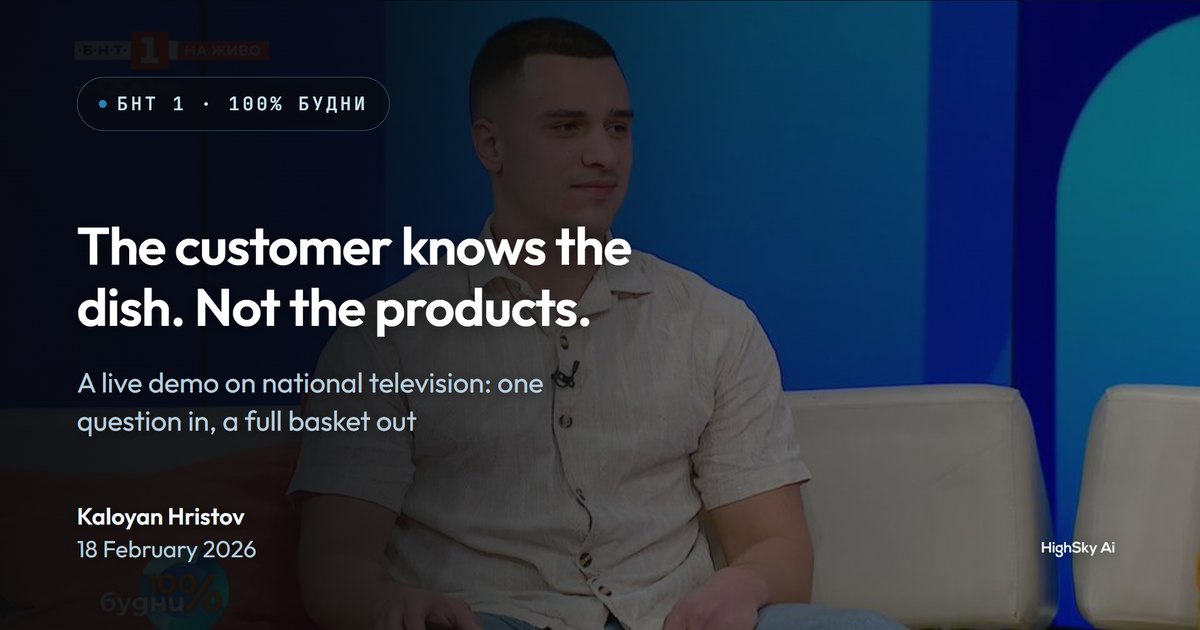
Demos on slides are safe. Demos on live national television are not, which is the only reason this one is worth writing up.
Our co-founder Kaloyan Hristov went on BNT 1 to show what an AI shopping agent actually does, using a working prototype of an online supermarket. The scenario the presenters were given was deliberately ordinary.
Someone wants to make moussaka. They do not know the recipe. They do not know what they need to buy.
"So they start having this natural human conversation."
What followed is a better explanation of conversational commerce than any feature list, mostly because the presenters kept interrupting with the questions a sceptical buyer would ask.
What the Agent Did
The customer says they want to cook moussaka. The agent works out the recipe, then works out which products in the store correspond to it, and starts assembling the basket.
Then the customer does what real customers do: "I already have potatoes, I have spices."
The agent removes them.
At which point it did something the presenters had not asked for. Having understood the customer's situation, it also put together a high-protein menu for the whole week.
"What we want to demonstrate is that with just a few sentences, you can literally do your shopping for the entire week."
Then the presenter jumped forward. What about a week later?
"It already sees that you are interested in a high-protein diet, and can show you other products much more personally, and some complementary recipes to help you reach your goals."
That is the mechanism in two moves. The first conversation resolves an intent. The second one starts from what the first one revealed. Nobody filled in a preference form and nobody clicked a filter.
Worth naming what the agent is doing commercially in that exchange. It began with a recipe and finished with a week's shop. That is a larger basket, and no part of it was a pop-up, a discount or a "customers also bought" strip. It was the answer to what the person actually asked for.
"Where Does It Get True Information From?"
The first hard question came fast. Where does the agent get verified, accurate information, so it does not simply make things up?
"Most often from the store itself." Beyond that, large general-purpose models supply the general knowledge about the world, and the store's own data is layered onto them.
Then the presenter asked whether they train it, and the answer was unambiguous:
"We teach them, of course. There is no other way. If you leave it to manage on its own, that often leads to hallucinations, wrong answers."
He then drew the line that decides how much this matters:
"Getting your moussaka wrong is not the biggest drama in the world. But if it starts giving you wrong recommendations, say about medicines, then it becomes a problem."
Which is why the system is built to slow down before it speaks. "It thinks, it reasons, it even generates several answers and sees which of them is the most accurate," comparing against the information it holds.
At which point one of the presenters said, with excellent timing, "I did not understand any of that."
That reaction is the whole communication problem in this category, and it is fair. The short version: the agent is not answering from memory. It checks, drafts, compares and only then replies. We go into the architecture that makes that possible in a separate piece on how these agents are built, and into the limits of the underlying models in this one.
What Happens When You Do Not Stock It
The best question of the segment was about stock, and it exposed something about how these systems get positioned.
The presenter asked what happens if he wants to make Peking duck and the store does not carry what he needs.
"It is trained to sell. It will point you to the closest similar thing."
"It is a merchant."
"It is a merchant. Its idea is to sell. And not just to sell whatever, but to sell something you would actually like. Something that fits your goals."
So instead of a dead end, the customer gets: we do not have that, here are the nearest options. Duck breast instead of the whole bird.
Then the presenters pushed on the obvious follow-up: could you influence it? Could it send a customer to another shop, or be made to always keep them here?
"Since we work with the merchant, there is no way we would send the customer to their competition. That would be unethical."
And when the product genuinely is not there, the agent says so: we do not have this product, here are the closest suggestions. "From there it depends on the user" whether they go elsewhere or take one of the alternatives.
This is a more honest answer than it first appears. A dead-end search costs you the sale and the visit. An alternative offered plainly gives the customer a real choice, which some of them will take. Nobody is trapped, and nobody is handed to a competitor either.
It Is Not Really About Groceries
One presenter asked whether this only applies to this kind of retail, or whether it works elsewhere. Bookshops, for instance.
"Absolutely. Bookshops are actually very good for it."
Then he stepped back to explain why, and this is the most transferable idea in the segment:
"This technology is a very strong and very smart search engine. It can work with an extremely wide database and filter out the thing that is most needed."
His example: a reader who wants something romantic, but with a light criminal note. The system returns exactly the novel that has both, because it holds the knowledge of every novel in that shop.
Try that as a keyword search. "Romantic" and "crime" as filters give you two categories that barely intersect and a list nobody will read to the bottom of. The intent behind the request never had a category.
That is the argument for AI search in any catalogue where the customer's need does not map onto your taxonomy. Which, at 20,000 items and up, is most needs.
How Far It Should Be Allowed to Go
A presenter asked whether he could ask the assistant for a Greek moussaka recipe rather than the one the store was suggesting.
"Absolutely, yes. But here it already depends on the merchant."
Some merchants want the agent limited strictly to what is in the store. Some want it to answer more general questions too. And some do not mind it going a long way off topic: "Some do not even mind us leaving it to write poems about Everest."
This is a configuration decision, not a capability one, and it is the sort of thing worth deciding deliberately rather than discovering later. An agent that refuses everything outside the catalogue feels like a search box. An agent with no boundary at all becomes a general chatbot your customers use for homework. The right answer sits between those, and it depends on your brand.
The Bulgarian Problem, and What It Took to Fix
Asked whether AI has learned Bulgarian, the answer was refreshingly unpolished.
"At the beginning it really was not good."
Bulgarian is difficult, and the difficulty is not evenly distributed. For text, he considers it solved: "In written form it does not make mistakes." For voice, it is a different job. The models get stress and intonation wrong, which makes the output sound unnatural even when every word is correct.
"Besides chats, we also build voice assistants. And that was one of the fairly big problems we ran into. We had to pay a great deal of attention to exactly that - intonation, stress and so on. But I dare say we managed."
If you sell in a language the large models treat as an afterthought, that is the detail to interrogate any voice AI vendor on. Not whether it speaks your language. Whether it sounds like it means it.
His read on the trajectory: this is the industry with the most money flowing into it right now, and where the money goes, development follows fastest.
On the Segment's Actual Topic: New Professions
The programme was built around how new professions managed entirely by AI come into being, and it is worth answering that directly rather than leaving it implied.
Nothing in the demo removed a person from a job. It removed a task from a person's day.
Somebody at that supermarket would otherwise have answered "what do I need for moussaka," "do you have this in stock," and "what can I substitute" several hundred times a week. That work is real, and almost nobody wants it to be their whole day. The roles that change are the ones defined by repetition, and what they change into is the part of the work that needed a human all along: the complicated cases, the annoyed customer, the judgement call, the relationship.
That is the version of this story we are willing to stand behind. Not fewer people. Different days.
FAQ
Where does an AI shopping agent get its product information? Primarily from the store itself - catalogue, stock, pricing, promotions, delivery rules. General-purpose models supply broad knowledge about the world, and the store's own data is layered on top so answers about products come from live data rather than model memory.
How do you stop it from inventing product details? By training it on the merchant's actual data and by making it reason before answering: drafting several candidate responses, comparing them against the information it holds, and returning the most accurate one. The stakes set the standard - a wrong recipe is recoverable, a wrong recommendation in pharmacy is not.
What does the agent do when a product is out of stock? It says so, and offers the nearest alternatives that fit what the customer described. It does not send the customer to a competitor, and it does not pretend the item exists.
Does this only work for groceries? No. It works best wherever a large catalogue meets a need that does not map onto categories. Bookshops are a strong example: "something romantic with a light criminal note" is a real request that keyword search cannot serve.
Can the agent answer questions unrelated to the store? That is a setting. Some merchants restrict it strictly to catalogue matters, others allow general questions. It is worth deciding on purpose, because both extremes have costs.
How good is AI in Bulgarian? For text, reliable. For voice, it takes deliberate work on stress and intonation, because the models get those wrong in Bulgarian even when the words are right.
Kaloyan Hristov is CEO and co-founder of HighSky AI and appeared on BNT 1. HighSky AI builds the SkyCommerce Suite for large online stores: AI Sales Agent, AI Search Engine, AI Voice Agent and Process Automation. To see this on your own catalogue instead of a prototype, book a demo.