300,000 Products, Seven Seconds, and the Questions It Refuses to Answer
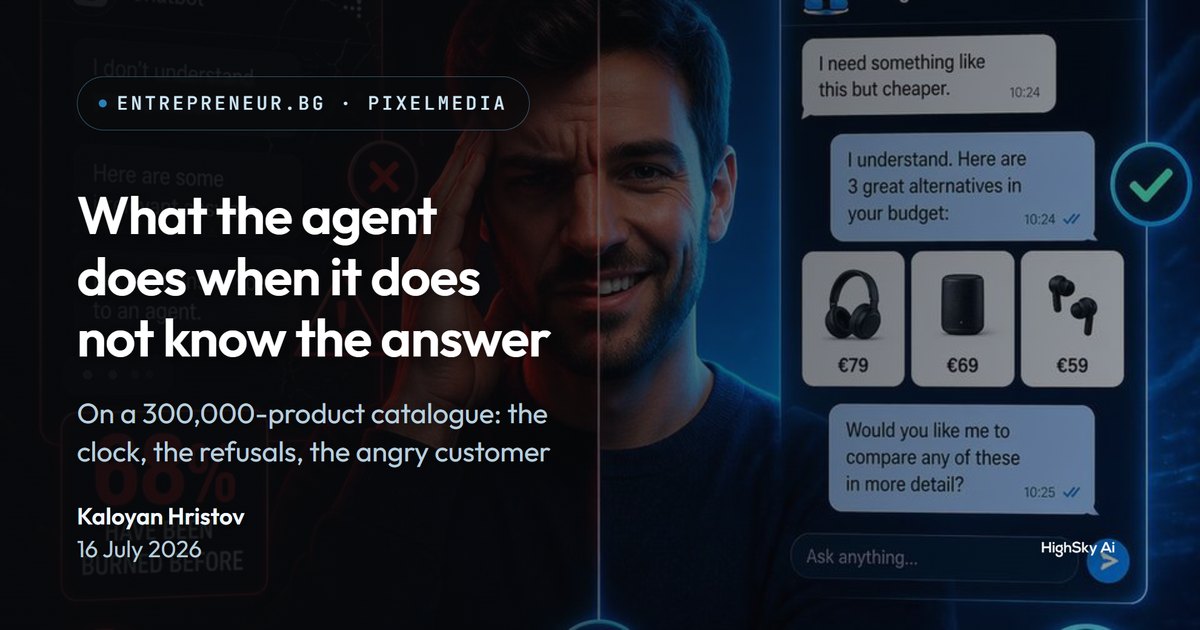
Most conversations about AI in retail stay at the level of what the technology could mean.
This one is about what it does between the moment a customer types a question and the moment an answer appears, because that interval is where the whole thing is either useful or theatre.
In July, our CEO Kaloyan Hristov went through the operational side of it in a press feature: how large a catalogue the agent works on, how long it takes to answer, what happens when it does not know, and what it does when the person on the other end is angry. None of that is visionary. All of it is what a merchant actually has to live with.
The Catalogue Sizes Where This Matters
The first question from anyone running a serious store is whether the thing survives contact with the catalogue.
"Electronics shops, home and garden shops and auto parts shops have the most items by count. AI agents can handle close to 300,000 articles quickly and effectively, and considerably more than that, without becoming a nuisance or making the process heavier. Sports goods and food supplements also have large catalogues, but those run in the range of 10,000 to 50,000."
Two things in that worth separating.
The first is the number. Three hundred thousand SKUs is not a demo catalogue. It is the size at which a human sales floor stops being able to know the inventory, at which filters stop narrowing anything usefully, and at which your search bar starts returning either nothing or everything.
The second is the shape of the system underneath. Capacity expands horizontally with load rather than degrading under it. However many people arrive, they get served. That is an architectural decision made early, and it is the difference between a tool that works in a quiet week and one that works on the day your campaign lands.
If you sell electronics, home and garden goods or auto parts, you are in the category with the hardest discovery problem in e-commerce, and the one where a competent AI Sales Agent has the most room to be worth its cost.
The Clock
Response time is where the comparison with existing support stops being flattering to existing support.
| Channel | Time to an answer |
|---|---|
| Person, live or by phone | 30 seconds to 2 minutes, plus the queue |
| 4 to 12 hours, often more than 24 | |
| Chat operator, at their best | 1 to 5 minutes of thinking or being absent |
| AI agent | 3 to 7 seconds |
Complex queries take longer. Occasionally the agent thinks for 15 to 20 seconds, and that is the ceiling rather than the average.
The number that deserves attention is not the seven seconds. It is the queue that is not in the agent's row, and the hour that is not in it either. At two in the morning on a Sunday, the answer arrives with the same quality it has on Tuesday afternoon. There is no shift ending, no backlog forming overnight, no first-response-time metric quietly getting worse in December.
For a store where a meaningful share of browsing happens after the support team has gone home, this is not a service improvement. It is the difference between a question being answered and a customer closing the tab.
What It Will Not Do
Ask the agent for legal advice, a medical dosage, or anything unconnected to the store, and it does not attempt an answer. It returns the conversation to the products, or it offers to put you through to a person.
That behaviour is deliberate, and Hristov defended it directly:
"This is not a weakness, it is a protection. The agent never invents stock levels, prices, or promises the shop cannot keep."
Where it has no information, it says so rather than improvising.
This is the least impressive-sounding property of the system and the most commercially important one. An agent that guesses at availability creates an order you cannot fulfil. An agent that guesses at a price creates a dispute you will lose. An agent that guesses at a delivery date creates a complaint, a refund, and a customer who tells other people.
Every one of those failures is more expensive than the sale it was reaching for. This is the same principle as the one behind a good assistant telling you no: a system that is allowed to disappoint you in small, honest ways is the only kind that will not disappoint you in large, expensive ones.
We have written separately about why the underlying technology is not clever in the way people assume, and about the architecture that keeps invention out of the answers.
The Angry Customer
Tone handling is the part most people do not think to ask about until it goes wrong in public.
A late order or a wrong product produces a customer who is not looking for a product recommendation. The agent recognises the tone and adapts: it does not argue, it acknowledges the problem, it apologises on behalf of the shop, and it offers either a concrete solution or an escalation to a person.
What it does not do is take any of it personally. It has no mood that varies, no accumulated frustration from the previous four conversations, and no capacity to answer rudeness with rudeness.
That is worth stating plainly, because it is the one comparison where the machine wins on something other than speed. A human operator at the end of a long shift is doing their best against fatigue. The agent has no shift and no end of one.
With a customer in a good mood the behaviour inverts: it holds the tone, and it uses the moment for a relevant additional recommendation rather than a generic one.
Typos
Small, but it belongs in an operational list.
Misspell a product name and the agent still returns the relevant results. Your search bar almost certainly does not, and the visitors it fails this way do not report the failure. They leave, and nothing on your dashboard records why. Our AI Search Engine exists because that particular silence is expensive.
One Correction, Repeated
The same press cycle carried a line saying the system becomes more intelligent the more it is used.
We corrected that publicly when it first appeared, and it holds here too. The system generates data and that data informs improvement, but the improvement is work someone does: reviewing conversations, fixing gaps in the catalogue, retraining. It is not automatic, it is not passive, and describing it as automatic sets an expectation that no responsible implementation will meet.
We would rather correct our own press coverage than inherit the expectation.
What a Merchant Should Take From This
None of the above is a promise about your revenue. It is a description of behaviour, which is the thing you can actually evaluate before signing anything.
The questions worth asking any vendor in this category are the boring ones. How large a catalogue, verified on a catalogue that size. How fast, measured at peak rather than in a demo. What happens when it does not know. What happens when the customer is furious. What happens at 2am.
If a vendor cannot answer those four without changing the subject to the roadmap, that is the answer.
If you want to see the behaviour on your own catalogue rather than on a slide, that is a short conversation.
FAQ
How many products can an AI sales agent handle? Close to 300,000 articles and considerably more, according to HighSky AI. The largest catalogues by item count are electronics, home and garden, and auto parts. Sports goods and food supplements typically run between 10,000 and 50,000.
How fast does an AI agent respond? Between 3 and 7 seconds for a typical question. Complex queries occasionally take 15 to 20 seconds. For comparison, a person answering live or by phone takes 30 seconds to 2 minutes plus queue time, and email commonly takes 4 to 12 hours.
What happens when the agent does not know the answer? It says so. For questions outside its scope, such as legal advice or medical dosages, it returns the conversation to the products or offers a handover to a person. It does not invent stock levels, prices, or delivery promises.
How does an AI agent handle an angry customer? It acknowledges the problem, apologises on behalf of the shop, and offers a concrete solution or an escalation to a human. It does not argue and does not respond to rudeness in kind.
Does the agent work outside business hours? Yes, at the same quality. There is no queue, no shift, and no overnight backlog. This matters most for stores where a significant share of browsing happens after the support team has finished for the day.
Does the system get smarter automatically the more it is used? No. It generates data that informs improvement, but the improvement is deliberate work: reviewing conversations, fixing catalogue gaps and retraining. Any claim that it improves passively should be treated with suspicion.
Kaloyan Hristov is CEO and co-founder of HighSky AI. This feature was published by Pixelmedia.bg and Entrepreneur.bg on 16 July 2026. HighSky AI builds the SkyCommerce Suite for large online stores: AI Sales Agent, AI Search Engine, AI Voice Agent and Process Automation.